
 Français
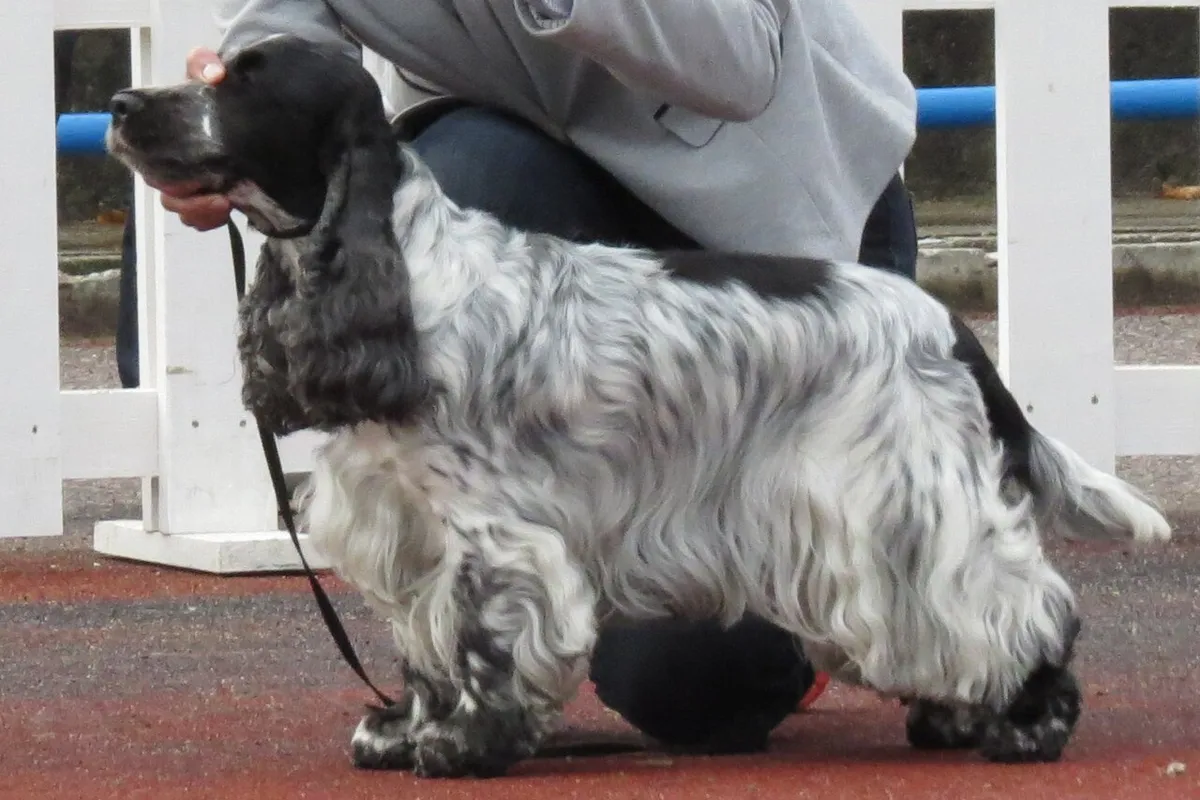
At a glance
| Trait | Detail |
|---|---|
| Origin | Great Britain [1] |
| Breed group | FCI Group 8 (Retrievers, flushing dogs, water dogs), section 2, flushing dogs; AKC Sporting Group [1, 2] |
| Weight | About 29–32 lb (13–14.5 kg) in the breed standard [1]; median adult weight 33.2 lb (15.05 kg) in UK practices [4] |
| Height | Males about 15.5–16 in (39–41 cm), females about 15–15.5 in (38–39 cm) [1] |
| Life expectancy | Median age at death 11.4 years in UK veterinary records [4]; median 13.3 years in a 2024 UK study [5] |
| Coat | Flat and silky; solid colors (black, red, golden, liver, black and tan, liver and tan), bicolors, tricolors and roans [1] |
Origin
The breed takes its name from the “cocking spaniel”, used to flush woodcock. Cocker Spaniels were recognized as a breed separate from Field and Springer Spaniels soon after the Kennel Club was founded in 1873. As in other gundog breeds, working and show lines now differ, the show Cocker being sturdier and heavier [1].
The American Cocker Spaniel is a separate breed of US origin with its own standard [3]; the studies on this page concern the English Cocker unless stated otherwise. In 2016 English Cocker Spaniels made up 3.06% of dogs under primary veterinary care in the UK [4].
Common health problems
- Everyday problems: among 10,313 English Cocker Spaniels in UK practices, the most common diagnoses were periodontal disease (20.97%), otitis externa (10.09%), obesity (9.88%), anal sac impaction (8.07%) and diarrhea (4.87%) [4].
- Ears: compared with other dogs, English Cockers had 14.66 times the odds of ear discharge and 1.40 times the odds of otitis externa. The long, hanging ears are likely an important predisposing factor [6].
- Eyes: the odds of dry eye (keratoconjunctivitis sicca) were 7.64 times higher, and those of cataract 1.90 times higher, than in other dogs [6].
- Skin allergy: unlike many breeds, English Cockers had lower odds of atopic dermatitis (odds ratio 0.14) [6].
- Immune-mediated hemolytic anemia (IMHA): Cocker Spaniels are predisposed to this disease, in which the immune system destroys red blood cells [7]. In a US case-control study, Cocker Spaniels were among the breeds with a significantly increased risk [8]. See IMHA in dogs and anemia in dogs.
- Kidneys: autosomal recessive hereditary nephropathy is caused by a COL4A4 mutation; the mutation was found in 39 of 114 English Cockers of unknown status in the study that identified it [9]. In UK practices, Cocker Spaniels were also at higher risk of chronic kidney disease [11]. See kidney disease in dogs.
- Hormones and pancreas: English Cockers had 2.10 times the odds of hypothyroidism of crossbred dogs [12], and the breed has been reported as predisposed to pancreatitis [6]. See hypothyroidism in dogs and pancreatitis in dogs.
- Causes of death: the most common were neoplasia (9.26%), mass-associated disorders (8.33%) and collapse (7.41%) [4].
What is special in the Cocker Spaniel’s blood work
We found no published breed-specific reference intervals for routine blood values in English Cocker Spaniels. What matters most is knowing which results point to the breed’s known diseases.
Anemia. A low hematocrit in a Cocker Spaniel, especially with signs of red-cell destruction, raises the question of IMHA, to which the breed is predisposed [7]. See IMHA in dogs.
Urine protein and the DNA test. In puppies with hereditary nephropathy, protein in the urine was the first abnormality, from 5 to 8 months of age, and kidney values rose 2 to 9 months later. Screening at-risk Cockers for proteinuria detects the disease early; a kidney biopsy examined by electron microscopy confirms it [10]. A DNA test for the COL4A4 mutation identifies affected dogs and carriers [9]. See protein in urine.
Kidney values in older dogs. Cocker Spaniels were among the breeds at higher risk of chronic kidney disease in UK practices [11], so creatinine, SDMA and urine tests are worth repeating over time.
Thyroid. Hypothyroidism is more common than in crossbred dogs [12], and it can also trigger ear disease and coat changes [6].
Tear test. Dry eye may be missed without a Schirmer tear test, which the authors of the UK study recommend for English Cockers with conjunctivitis or eye discharge of unknown cause [6].
Related articles
En français : Cocker.
Questions to ask your veterinarian
- Has my Cocker been DNA-tested for hereditary nephropathy, or were both parents tested clear?
- Should we check a urine protein (UPC) ratio in my young Cocker?
- Are my dog’s ear problems linked to the ear shape, an allergy or the thyroid?
- Could a Schirmer tear test explain my dog’s eye discharge?
- If my Cocker suddenly becomes weak or pale, which blood tests would show IMHA?
Get your Cocker Spaniel’s blood work explained.
AI DiagAnimals reads the blood count, kidney values, urine protein and thyroid results together with your laboratory’s intervals, and flags the values linked to the Cocker’s known diseases. The service opens soon: leave your email to be told first.
Frequently asked questions
How long do Cocker Spaniels live?
In UK veterinary records, the median age at death of English Cocker Spaniels was 11.4 years [4]. A 2024 UK study found a median lifespan of 13.3 years [5].
What health problems do Cocker Spaniels have?
Dental disease, ear inflammation and obesity are the most common in daily practice [4]. Compared with other dogs, English Cockers have much higher odds of ear discharge and dry eye [6], and Cocker Spaniels are predisposed to immune-mediated hemolytic anemia [7].
Why do Cocker Spaniels get so many ear infections?
Otitis externa affected about 1 in 10 English Cockers in a year [4]. Their long, hanging ears are likely an important predisposing factor; allergy appeared to play a smaller role than in other breeds [6].
What is hereditary nephropathy in Cocker Spaniels?
An inherited kidney disease caused by a COL4A4 mutation, passed on when both parents carry it [9]. Affected puppies first show protein in the urine, then rising kidney values months later [10].
What tests should a Cocker Spaniel have?
A DNA test can tell whether a dog carries the hereditary nephropathy mutation [9], and urine protein screening detects affected young dogs early [10]. Because dry eye is common, a Schirmer tear test is useful in a Cocker with eye discharge or conjunctivitis [6].
Sources
- FCI. Standard No. 5: English Cocker Spaniel. 2026. fci.be/Nomenclature/Standards/005g08-en.pdf
- American Kennel Club. English Cocker Spaniel: dog breed information. akc.org/dog-breeds/english-cocker-spaniel
- FCI. Standard No. 167: American Cocker Spaniel. 2021. fci.be/Nomenclature/Standards/167g08-en.pdf
- Engdahl KS et al. Demography and disorders of English Cocker Spaniels under primary veterinary care in the UK. Canine Med Genet. 2023;10:4. doi.org/10.1186/s40575-023-00128-x
- McMillan KM et al. Longevity of companion dog breeds: those at risk from early death. Sci Rep. 2024;14:531 (supplementary Table S3). doi.org/10.1038/s41598-023-50458-w
- Engdahl KS et al. English Cocker Spaniels under primary veterinary care in the UK: disorder predispositions and protections. Canine Med Genet. 2024;11:1. doi.org/10.1186/s40575-023-00136-x
- Threlfall AJ et al. Analysis of DLA-DQB1 and polymorphisms in CTLA4 in Cocker spaniels affected with immune-mediated haemolytic anaemia. Canine Genet Epidemiol. 2015;2:8. doi.org/10.1186/s40575-015-0020-y
- Miller SA et al. Case-control study of blood type, breed, sex, and bacteremia in dogs with immune-mediated hemolytic anemia. J Am Vet Med Assoc. 2004;224(2):232-235. doi.org/10.2460/javma.2004.224.232
- Davidson AG et al. Genetic cause of autosomal recessive hereditary nephropathy in the English Cocker Spaniel. J Vet Intern Med. 2007;21(3):394-401. doi.org/10.1892/0891-6640(2007)21[394:gcoarh]2.0.co;2
- Lees GE et al. Early diagnosis of familial nephropathy in English cocker spaniels. J Am Anim Hosp Assoc. 1998;34(3):189-195. doi.org/10.5326/15473317-34-3-189
- O’Neill DG et al. Chronic kidney disease in dogs in UK veterinary practices: prevalence, risk factors, and survival. J Vet Intern Med. 2013;27(4):814-821. doi.org/10.1111/jvim.12090
- O’Neill DG et al. Frequency, breed predispositions and other demographic risk factors for diagnosis of hypothyroidism in dogs under primary veterinary care in the UK. Canine Med Genet. 2022;9:11. doi.org/10.1186/s40575-022-00123-8
Laboratory methods and reference intervals vary. This article explains; it does not diagnose. For a decision about your pet, use the original report and talk to your veterinarian. Our editorial policy.