
 Français
At a glance
| Trait | Detail |
|---|---|
| Origin | Germany [1] |
| Breed group | FCI group 2, section 2.1 (Molossoid breeds, Mastiff type) [1]; AKC Working Group [2] |
| Weight | Median adult weight in UK practices 133 lb (60.5 kg): females 123 lb (56.0 kg), males 143 lb (64.9 kg) [3] |
| Height | Males at least 31.5 in (80 cm), not over 35.5 in (90 cm); females at least 28.5 in (72 cm), not over 33 in (84 cm) [1] |
| Life expectancy | Median age at death 8.9 years in UK veterinary records [3]; median 10.6 years in a large UK study [4] |
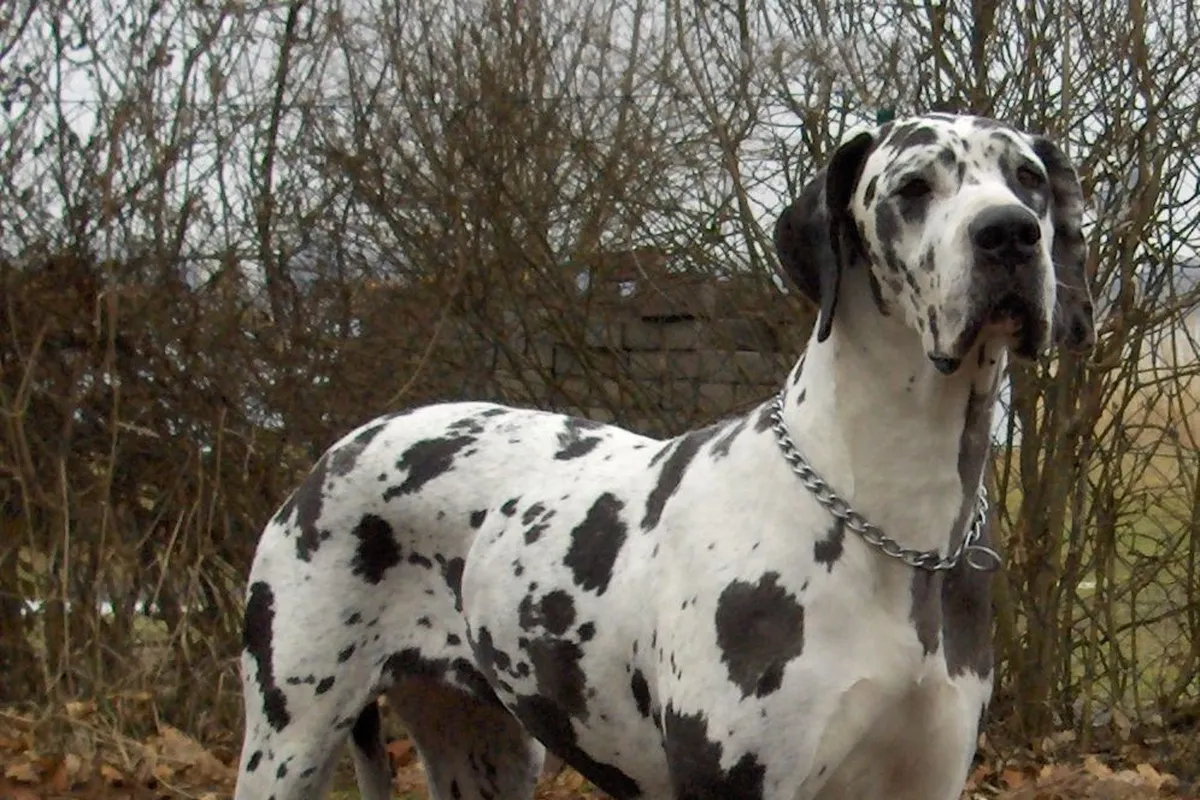
| Coat | Very short, dense, smooth and glossy; fawn and brindle, harlequin, merle and black, or blue [1] |
Origin
The forerunners of the Great Dane were the old “Bullenbeisser” and the hunting and wild boar hounds, midway between the English-type Mastiff and the Greyhound. In 1878 a committee of breeders and judges in Berlin decided to group these varieties as “Deutsche Doggen”, laying the foundation of a German breed [1].
The first standard was laid down at a show in Berlin in 1880, and it has been looked after since 1888 by the German Great Dane club, the Deutsche Doggen Club 1888 [1].
Common health problems
- Gastric dilatation-volvulus (GDV, bloat): the stomach fills with gas and can twist. In UK emergency clinics, Great Danes had 114.3 times the odds of crossbreeds of a GDV diagnosis, the highest of all breeds. About 80% of dogs treated surgically survived to discharge [5]. The estimated lifetime risk of GDV in Great Danes is 36.7% [6].
- Dilated cardiomyopathy (DCM): in 107 UK Great Danes screened with heart ultrasound and ECG, 35.6% were affected, and 47% with revised breed reference values. Irregular ventricular beats were common, in 54% of affected dogs, and the pedigrees suggested dominant inheritance [7]. See heart failure in dogs.
- Osteosarcoma (bone cancer): 0.87% of Great Danes in UK practices had osteosarcoma in one year, with 34.24 times the odds of crossbreeds [9].
- Wobbler syndrome (cervical spondylomyelopathy): a compression of the spinal cord in the neck that mainly affects large and giant breeds. It is often studied in Great Danes and Dobermans, and the disc-associated form is more common in Dobermans than in Great Danes [10].
- Short life: across 29 giant breeds in UK practices, the median age at death was 8.94 years, and neoplasia, collapse and heart disorders were the most common causes of death [3].
What is special in the Great Dane’s blood work
We found no published Great Dane-specific reference intervals for routine blood tests. The tests that matter most in the breed are linked to the heart and to emergencies such as bloat.
Troponin I. Troponin I is a blood marker of heart muscle damage. In 124 Great Danes screened for DCM, it was higher in dogs with clinical DCM and in dogs with irregular ventricular beats. A value above 0.199 ng/mL was linked to shorter survival and a higher risk of sudden cardiac death, and the authors see it as a useful extra screening tool [8].
Heart screening. Screening for hidden DCM is advised from 3 years of age, repeated every year, with heart ultrasound and a 24-hour ECG (Holter), which may be useful in breeds other than Dobermans and Boxers [11]. Great Danes need sex- or weight-based ultrasound reference values [7].
Lactate in bloat. In dogs with GDV, a lower blood lactate, or one that falls after fluids, is linked to a better outlook. Values overlap a lot between dogs that survive and those that do not, so lactate should not be used alone to give a prognosis or to decide against surgery [12].
Bone cancer. What a raised ALP means in dogs with osteosarcoma is explained on our Rottweiler page; see also high ALP in dogs.
Other values. Our CBC guide explains the blood count line by line.
Related articles
En français : Dogue allemand.
Questions to ask your veterinarian
- What are the signs of bloat, and what should I do if I see them?
- Would a preventive gastropexy make sense for my Great Dane?
- When should my dog start heart screening with ultrasound and Holter?
- Would a troponin I test add useful information?
- If my dog starts limping or walks unsteadily, which tests come first?
Get your Great Dane’s blood work explained.
AI DiagAnimals reads the blood count, troponin and NT-proBNP, liver and kidney values together with your laboratory’s intervals, and explains them in plain language. The service opens soon: leave your email to be told first.
Frequently asked questions
How long do Great Danes live?
In UK veterinary records, Great Danes that died did so at a median age of 8.9 years [3]. A larger UK study found a median lifespan of 10.6 years [4].
Are Great Danes prone to bloat?
Yes. They had 114.3 times the odds of crossbreeds of a GDV diagnosis in UK emergency clinics [5], and their estimated lifetime risk is 36.7% [6].
Do Great Danes get heart disease?
Dilated cardiomyopathy is common: 35.6% of UK Great Danes screened were affected, up to 47% with revised reference values [7].
Sources
- FCI. Standard No. 235: Deutsche Dogge (Great Dane). 2024. fci.be/Nomenclature/Standards/235g02-en.pdf
- American Kennel Club. Great Dane: dog breed information. akc.org/dog-breeds/great-dane
- O’Neill DG et al. Giant dog breeds under primary veterinary care in the UK: demography, common disorders and mortality. Companion Anim Health Genet. 2026;13:4. doi.org/10.1186/s40575-026-00152-7
- McMillan KM et al. Longevity of companion dog breeds: those at risk from early death. Sci Rep. 2024;14:531 (supplementary table S3). doi.org/10.1038/s41598-023-50458-w
- O’Neill DG et al. Gastric dilation-volvulus in dogs attending UK emergency-care veterinary practices: prevalence, risk factors and survival. J Small Anim Pract. 2017;58(11):629-638. doi.org/10.1111/jsap.12723
- Ward MP, Patronek GJ, Glickman LT. Benefits of prophylactic gastropexy for dogs at risk of gastric dilatation-volvulus. Prev Vet Med. 2003;60(4):319-329. doi.org/10.1016/s0167-5877(03)00142-9
- Stephenson HM et al. Screening for dilated cardiomyopathy in Great Danes in the United Kingdom. J Vet Intern Med. 2012;26(5):1140-1147. doi.org/10.1111/j.1939-1676.2012.00987.x
- El Sharkawy S et al. Long-term outcome and troponin I concentrations in Great Danes screened for dilated cardiomyopathy: an observational retrospective epidemiological study. J Vet Cardiol. 2023;47:1-13. doi.org/10.1016/j.jvc.2023.03.003
- O’Neill DG et al. Dog breeds and conformations predisposed to osteosarcoma in the UK: a VetCompass study. Canine Med Genet. 2023;10:8. doi.org/10.1186/s40575-023-00131-2
- Bonelli MA et al. Comparison of angle, shape, and position of articular processes in Dobermans and Great Danes with and without cervical spondylomyelopathy. BMC Vet Res. 2017;13:77. doi.org/10.1186/s12917-017-0997-4
- Wess G. Screening for dilated cardiomyopathy in dogs. J Vet Cardiol. 2022;40:51-68. doi.org/10.1016/j.jvc.2021.09.004
- Mackenzie D. Gastric dilatation volvulus in dogs: utility of lactate as a predictor of survival. Vet Evid. 2022;7(4). doi.org/10.18849/ve.v7i4.537
Laboratory methods and reference intervals vary. This article explains; it does not diagnose. For a decision about your pet, use the original report and talk to your veterinarian. Our editorial policy.