
 Français
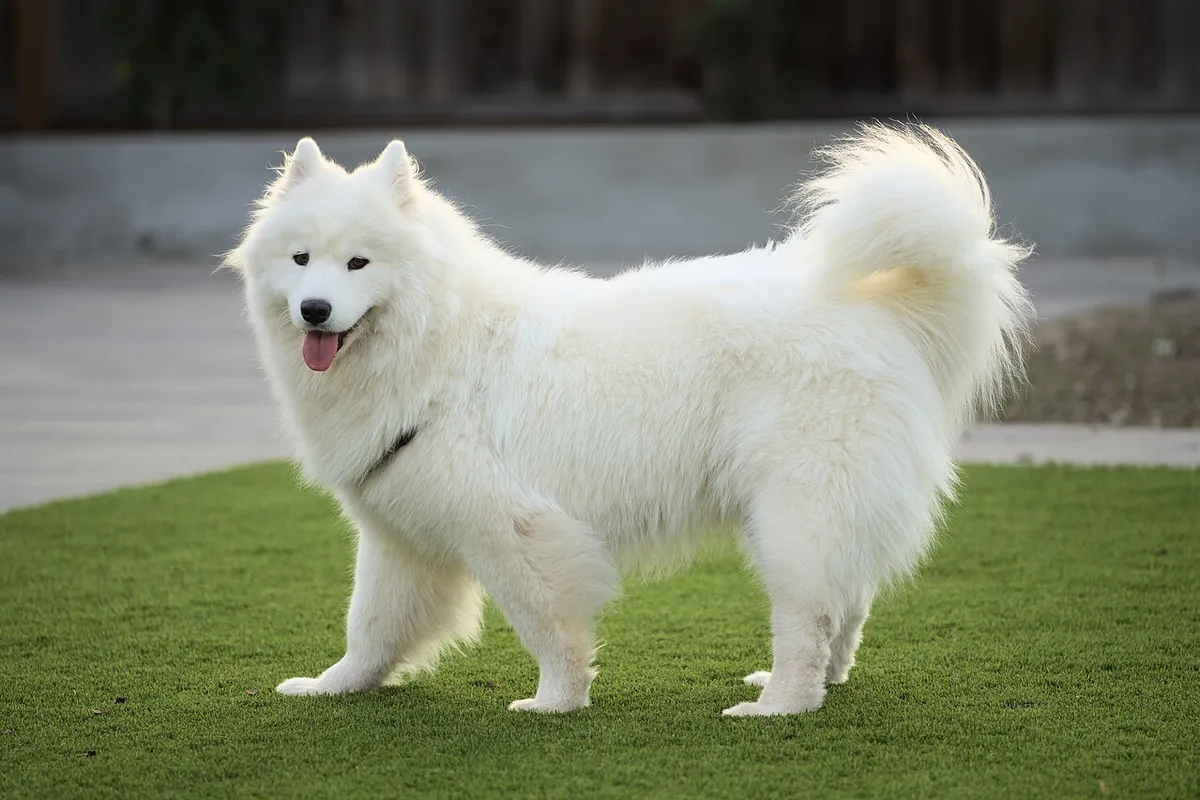
At a glance
| Trait | Detail |
|---|---|
| Origin | Northern Russia and Siberia [1] |
| Breed group | FCI group 5, section 1 (Nordic sledge dogs) [1]; AKC Working Group [2] |
| Weight | Males 45–65 lb (20–29 kg), females 35–50 lb (16–23 kg) [2] |
| Height | Ideal about 22.5 in (57 cm) for males and about 21 in (53 cm) for females, with a tolerance of 3 cm (about 1 in) [1] |
| Life expectancy | Median 13.1 years in a 2024 UK study of over 580,000 dogs [3] |
| Coat | Thick double coat; pure white, cream, or white with biscuit [1] |
Origin
The breed takes its name from the Samoyed peoples of northern Russia and Siberia. In the north their dogs were pure white and were used for hunting and pulling sledges; they lived close to their owners and even slept inside their shelters to keep them warm [1].
The British zoologist Ernest Kilburn Scott spent three months among the Samoyed peoples in 1889 and brought back a puppy to England, followed by a few more dogs. These dogs, and those brought back by polar explorers, founded the Western Samoyed, and the first standard was written in England in 1909 [1].
Common health problems
- Diabetes mellitus: Samoyeds were at high risk in a US referral hospital study [4], among the four breeds with the highest incidence in 180,000 insured Swedish dogs [5], and among the breeds at highest risk in Norway, where 70% of diabetic Samoyeds were females, at a mean age of 9.1 years [6]. See diabetes in dogs.
- Inherited kidney disease: Samoyed hereditary glomerulopathy is an X-linked disease described in a family of Samoyeds, in which 60% of males developed severe kidney disease and kidney failure before 15 months of age, while carrier females had milder disease [7]. It is a model of human hereditary nephritis [7]. See kidney disease in dogs.
- Glaucoma and the drainage angle: in 203 Swedish Samoyeds, about 25% of eyes had pectinate ligament dysplasia and 6 dogs had glaucoma with a fully closed drainage angle [8].
- Oculoskeletal dysplasia: an autosomal recessive disease with short-limbed dwarfism and severe eye defects. In Samoyeds it is linked to a deletion in the COL9A2 gene [9].
- Progressive retinal atrophy: an X-linked form (XLPRA1), caused by a mutation in the RPGR gene, is found in the Samoyed and the Siberian Husky [10].
What is special in the Samoyed’s blood work
We found no breed-specific reference intervals for the Samoyed. The breed’s predispositions, however, show on routine blood and urine tests.
Glucose and fructosamine. The Norwegian study identified diabetic dogs from laboratory samples with a fructosamine above 315 µmol/L. The Samoyed’s odds of diabetes were 4.5 times those of all dogs tested and 3.2 times those of registered dogs [6]. Our guide to blood sugar in dogs explains how glucose results are read.
Urine protein first, then creatinine. In the Samoyed family with hereditary glomerulopathy, affected males had protein in the urine from 2 to 3 months of age and a falling filtration rate from 3 months. From 4 to 5 months, blood albumin fell while urea, creatinine, phosphate and amylase rose. Carrier females also developed proteinuria, but not kidney failure [11].
Unusual eosinophils. In one Samoyed family, a male and its five offspring had a marked and persistent eosinophil increase with immature band eosinophils, after acquired causes such as allergy or parasites had been ruled out. Some of these dogs also had eye and skeletal abnormalities [12].
Eye screening. Gonioscopy assesses the drainage angle, and eyes with a closed angle had higher eye pressure [8].
Related articles
En français : Samoyède.
Questions to ask your veterinarian
- Should my Samoyed’s blood glucose or fructosamine be checked at its yearly visit?
- Which signs of diabetes, such as drinking more, should make me call you?
- Should a urine test with a protein measurement be part of my dog’s check-ups?
- Has my dog had a gonioscopy, and should it be repeated?
- Were the parents DNA-tested for the inherited eye diseases known in the breed?
Get your Samoyed’s blood work explained.
AI DiagAnimals reads glucose, fructosamine, kidney values, urine protein and other results together with your laboratory’s intervals, and explains them in plain language. The service opens soon: leave your email to be told first.
Frequently asked questions
How long do Samoyeds live?
A 2024 UK study of over 580,000 dogs found a median lifespan of 13.1 years for Samoyeds [3].
Are Samoyeds prone to diabetes?
Yes. The breed was at high risk in the United States [4], Sweden [5] and Norway, where its odds were 3.2 to 4.5 times those of other dogs [6].
What kidney disease affects Samoyeds?
Samoyed hereditary glomerulopathy, an X-linked disease described in a family of Samoyeds. Affected males lose protein in the urine within months and develop kidney failure before 15 months of age [7, 11].
Sources
- FCI. Standard No. 212: Samoiedskaïa Sabaka (Samoyed). 2019. fci.be/Nomenclature/Standards/212g05-en.pdf
- American Kennel Club. Samoyed: dog breed information. akc.org/dog-breeds/samoyed
- McMillan KM et al. Longevity of companion dog breeds: those at risk from early death. Sci Rep. 2024;14:531 (supplementary table S3). doi.org/10.1038/s41598-023-50458-w
- Hess RS et al. Breed distribution of dogs with diabetes mellitus admitted to a tertiary care facility. J Am Vet Med Assoc. 2000;216(9):1414-1417. doi.org/10.2460/javma.2000.216.1414
- Fall T et al. Diabetes mellitus in a population of 180,000 insured dogs: incidence, survival, and breed distribution. J Vet Intern Med. 2007;21(6):1209-1216. doi.org/10.1892/07-021.1
- Ringstad NK et al. Breed distributions for diabetes mellitus and hypothyroidism in Norwegian dogs. Canine Med Genet. 2022;9:9. doi.org/10.1186/s40575-022-00121-w
- Jansen B et al. Mode of inheritance of Samoyed hereditary glomerulopathy: an animal model for hereditary nephritis in humans. J Lab Clin Med. 1986;107(6):551-555. pubmed.ncbi.nlm.nih.gov/3711721
- Ekesten B, Narfström K. Correlation of morphologic features of the iridocorneal angle to intraocular pressure in Samoyeds. Am J Vet Res. 1991;52(11):1875-1878. pubmed.ncbi.nlm.nih.gov/1785731
- Goldstein O et al. COL9A2 and COL9A3 mutations in canine autosomal recessive oculoskeletal dysplasia. Mamm Genome. 2010;21(7-8):398-408. doi.org/10.1007/s00335-010-9276-4
- Zangerl B et al. Independent origin and restricted distribution of RPGR deletions causing XLPRA. J Hered. 2007;98(5):526-530. doi.org/10.1093/jhered/esm060
- Jansen B et al. Samoyed hereditary glomerulopathy: serial, clinical and laboratory (urine, serum biochemistry and hematology) studies. Can J Vet Res. 1987;51(3):387-393. pubmed.ncbi.nlm.nih.gov/3651895
- Aroch I et al. Haematological, ocular and skeletal abnormalities in a samoyed family. J Small Anim Pract. 1996;37(7):333-339. doi.org/10.1111/j.1748-5827.1996.tb02403.x
Laboratory methods and reference intervals vary. This article explains; it does not diagnose. For a decision about your pet, use the original report and talk to your veterinarian. Our editorial policy.