
 Français
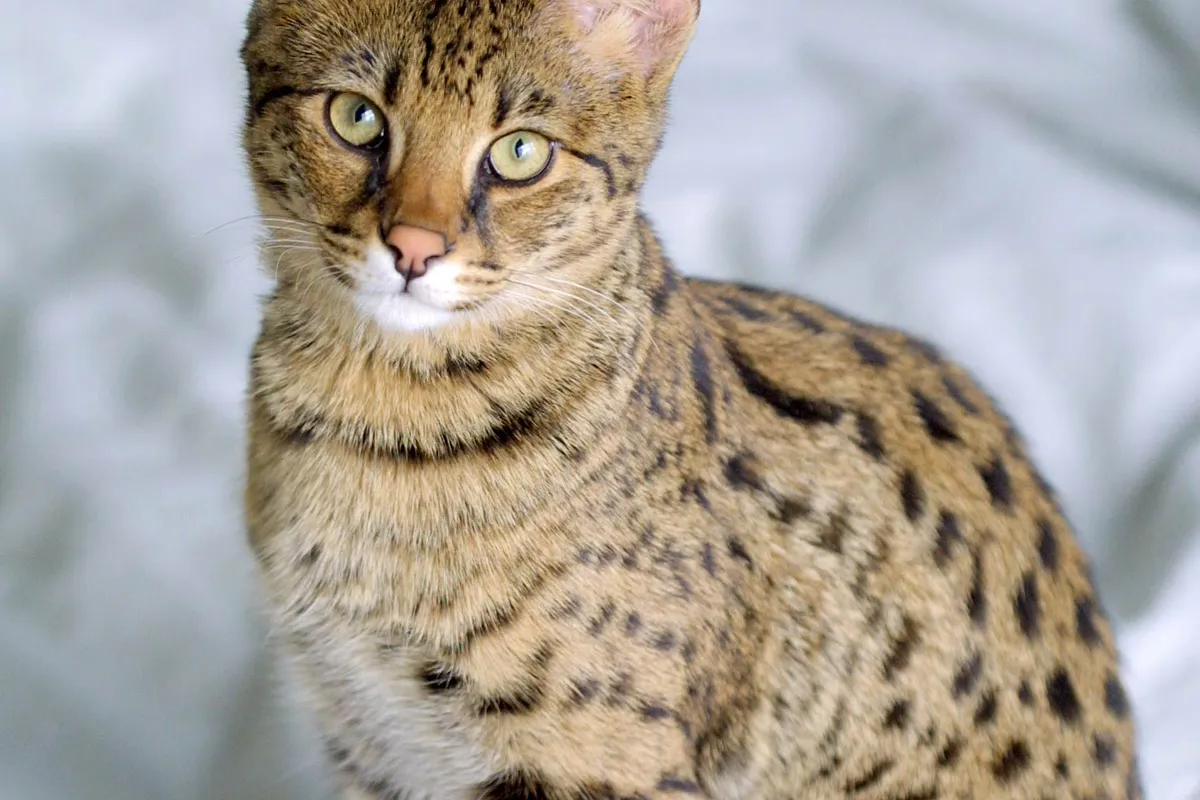
Savannah cat at a glance
| Trait | Detail |
|---|---|
| Origin | Hybrid of the serval (Leptailurus serval) and the domestic cat [1, 2] |
| Breed group | Not recognized by FIFe [3] |
| Build | Large and long-limbed, varying with generation: F1 males 18–24 lb (8–11 kg), exceptionally up to 40 lb (18 kg), and 16–18 in (40–45 cm) at the shoulder; F4 or F5 males 14–18 lb (6.3–8.2 kg); females slightly smaller [2] |
| Life expectancy | No published figure; the breed was not among those with 15 or more deaths in the 2024 UK life tables [4] |
| Coat | Tawny with dark spots, with long ears [2] |
Origin
Savannahs come from crossing domestic cats with servals [1]. Cats are described by generation, from F1 (the first cross) to later generations such as F4 and F5, which are smaller [2]. Domestic cats have 38 chromosomes, whereas most wild felids crossed with them have 36, which frequently reduces fertility or causes problems with pregnancy and birth [2]. Because gestation lengths differ, hybrid kittens may be born premature and undersized [1].
Rules on keeping Savannahs vary: Australia banned their import in 2008 [2], and some countries prohibit hybrids less than five generations removed from a wild ancestor [1]. The US Feline Veterinary Medical Association opposes breeding wild felids with domestic cats and discourages ownership of early generations (F1 to F3) because of their unpredictable behavior [1].
What is known about Savannah health
- Little evidence: we found no study of disease frequency or lifespan in Savannah cats; published reports are limited to genetic surveys of a handful of cats and single case reports [5, 6, 9].
- Pyruvate kinase deficiency (PK deficiency): an inherited cause of hemolytic anemia. One of 11 Savannahs tested carried one copy of the variant, and the authors recommend PK testing for Savannahs [5]. See anemia in cats and the Abyssinian and Bengal pages.
- Fibrodysplasia ossificans progressiva: a rare genetic disease in which muscle and connective tissue turn into bone, described in a 10-month-old Savannah; it was the first report of the disease in an exotic-breed cat [9].
- Vaccination: no rabies vaccine is approved by the US Department of Agriculture for wild or hybrid cats, although such cats have been shown to produce antibodies after vaccination; hybrid cats should still be vaccinated, and local laws may treat a bite differently [1].
- A note on the serval parent: a urine screening test for cystinuria, an inherited defect in amino acid transport that can cause stones, was positive or weakly positive in most of 26 captive servals in the United States [8]. Whether this concerns Savannahs has not been studied.
Tests and screening in Savannahs
- No breed reference intervals: we found no published reference values for blood counts or chemistry in Savannahs, so results can only be compared with general feline intervals; ask your vet how to read them. See cat blood work explained.
- DNA test for PK deficiency: recommended for the breed [5]. In affected cats, blood tests may show anemia, raised aggregate reticulocytes, high globulins and bilirubin [5].
- Blood type and crossmatching: in a German genotyping survey, all 10 Savannahs tested were type A [6]. In wild felids (the study included servals), blood typing cards and the DNA tests used in domestic cats may not identify the correct type, and only 7 of 26 crossmatches between domestic cats and wild felids were compatible; crossmatching before a transfusion is recommended [7]. Ask your vet about crossmatching, especially for early-generation cats. See anemia in cats.
- Kidney and urine tests: read like those of any cat. See creatinine and BUN in cats and urinalysis for dogs and cats.
Related articles
En français : Savannah.
Questions to ask your veterinarian
- Which generation is my Savannah, and does that change how you interpret its results?
- Has my cat been DNA tested for PK deficiency?
- If my cat ever needs a transfusion, will donor blood be crossmatched?
- Which vaccines do you recommend for a hybrid cat?
- Should we keep a baseline blood panel to compare future results with?
Get your Savannah’s blood work explained.
AI DiagAnimals reads the blood count, kidney values and the urinalysis with your laboratory’s intervals, compares them with earlier results and prepares the questions for your vet. The service opens soon: leave your email to be told first.
Frequently asked questions
How long do Savannah cats live?
There is no published figure. The 2024 UK life tables only gave separate results for breeds with 15 or more deaths, and the Savannah was not among them [4].
What health problems do Savannah cats have?
Very little is documented. A carrier of the PK deficiency variant was found among 11 Savannahs tested, and a single case of fibrodysplasia ossificans progressiva has been reported [5, 9].
Are Savannah cats’ blood test results different?
We found no study of this and no published breed reference values. What is known: the few Savannahs typed were blood type A, and crossmatching is advised before transfusions involving wild felids [6, 7].
What is an F1 Savannah?
A first-generation cross between a serval and a domestic cat, the generation closest to the wild ancestor. F1 males can weigh 18–24 lb (8–11 kg), more than later generations such as F4 or F5 [1, 2].
Can Savannah cats get a rabies vaccine?
No rabies vaccine is approved in the United States for hybrid cats, but hybrid and wild cats have been shown to make antibodies after vaccination, and vaccination is still advised [1].
Sources
- Feline Veterinary Medical Association. 2025 Hybrid Cats Position Statement. catvets.com/resource/2025-hybrid-cats-position-statement
- Dickman CR et al. Assessing risks to wildlife from free-roaming hybrid cats: the proposed introduction of pet Savannah cats to Australia as a case study. Animals (Basel). 2019;9(10):795. doi.org/10.3390/ani9100795
- Fédération Internationale Féline. Breeds and standards. fifeweb.org/cats/breeds
- Teng KT et al. Life tables of annual life expectancy and risk factors for mortality in cats in the UK. J Feline Med Surg. 2024;26(5):1098612X241234556. doi.org/10.1177/1098612X241234556
- Grahn RA et al. Erythrocyte pyruvate kinase deficiency mutation identified in multiple breeds of domestic cats. BMC Vet Res. 2012;8:207. doi.org/10.1186/1746-6148-8-207
- Kehl A et al. CMAH genotyping survey for blood types A, B and C (AB) in purpose-bred cats. Anim Genet. 2019;50(3):303-306. doi.org/10.1111/age.12778
- Parkinson L et al. Nondomestic felid ABC blood phenotyping, genotyping, and crossmatching. J Zoo Wildl Med. 2024;55(1):143-154. doi.org/10.1638/2023-0025
- Cannizzo SA et al. Prevalence of cystinuria in servals (Leptailurus serval) in the United States. J Zoo Wildl Med. 2017;48(4):1102-1107. doi.org/10.1638/2016-0177.1
- Jacobsen KL et al. Use of enrofloxacin and hydrotherapy in the management of fibrodysplasia ossificans progressiva (FOP) in a Savannah cat. Top Companion Anim Med. 2023;52:100757. doi.org/10.1016/j.tcam.2022.100757
Laboratory methods and reference intervals vary. This article explains; it does not diagnose. For a decision about your pet, use the original report and talk to your veterinarian. Our editorial policy.