
 Français
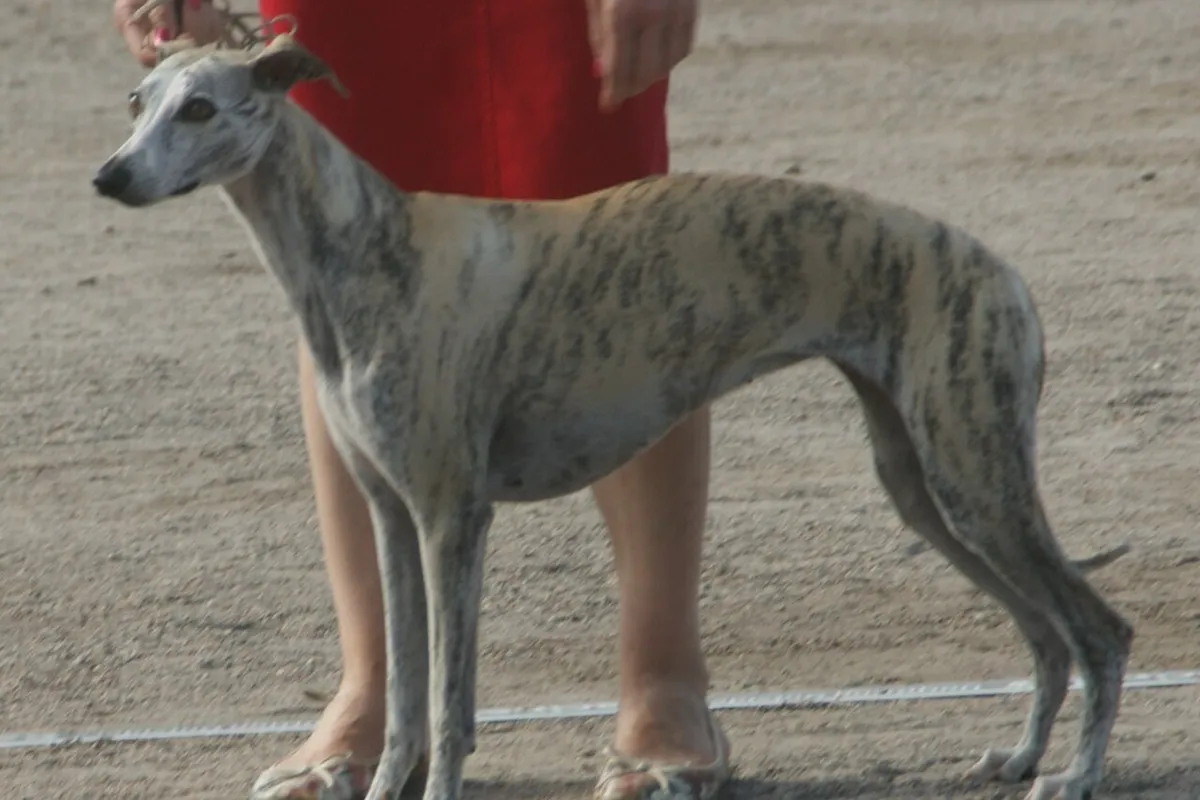
At a glance
| Trait | Detail |
|---|---|
| Origin | Great Britain [1] |
| Breed group | FCI group 10, section 3 (short-haired sighthounds) [1]; AKC Hound Group [2] |
| Weight | 25–40 lb (11–18 kg) [2] |
| Height | Males 18.5–20 in (47–51 cm), females 17.5–18.5 in (44–47 cm) [1] |
| Life expectancy | Median 13.4 years in a large UK study [3] |
| Coat | Fine, short and close; any color or mixture of colors, merle not accepted [1] |
Origin
The Whippet was developed in the late 1800s specifically for racing. Despite its small size it can run at up to 35 miles per hour (about 56 km/h) [5]. The American Kennel Club calls it the “Poor Man’s Racehorse” [2].
Whippets and Greyhounds share a common ancestral gene pool, and the two breeds are hard to separate in genetic studies [5]. The breed standard describes a dog built for speed and work, in which all exaggeration should be avoided [1].
Common health problems
In the 2014 Kennel Club survey of UK pedigree dogs, 79.2% of 707 live Whippets had no disease or condition reported by their owner, the highest share among the 41 breeds with at least 200 dogs [4]. The problems below are those that studies single out in the breed.
- Most reported conditions: in the same survey, the most frequent were an undescended testicle (cryptorchidism, 1.98%), lipoma (1.56%) and colitis (1.41%) [4].
- Steroid-responsive meningitis-arteritis (SRMA): in a UK referral study of dogs up to 2 years old, Whippets made up 11 of 60 SRMA cases (18%) but only 2 of 180 controls (1%), with about 39 times the odds of other breeds. Vaccination and time of year were not linked to the disease [6]. Affected dogs show neck pain, dullness and fever, and the diagnosis rests on the clinical signs, laboratory findings and exclusion of other causes [6]. See white blood cell count in dogs.
- Neck (cervical) disc disease: in an online survey of 280 Italian Whippets, 7.2% had cervical disc disease, rising to 29% of Whippets older than 9 years [7].
- Mitral valve disease: Whippets are overrepresented for degenerative mitral valve disease, and its severity is linked to regions of chromosomes 15 and 2, which suggests a genetic basis in the breed [8]. See heart failure in dogs.
- “Bully” Whippets: dogs with two copies of a two-base deletion in the myostatin (MSTN) gene are grossly overmuscled; owners report muscle cramping. Carriers of one copy are more muscular and over-represented among the fastest racers. In 146 Whippets sampled without regard to family history, 2 had two copies and 20 had one [5].
What is special in the Whippet’s tests
Sighthounds are known to have laboratory values that differ from other breeds, and the Whippet is no exception. What has been measured in the breed:
- A profile close to the Greyhound’s. In a study of 192 dogs of eight sighthound breeds, the Whippet had the laboratory profile most similar to the Greyhound. The authors still advise against applying the Greyhound profile to other sighthounds, because their reference intervals often differ [10]. The Greyhound page shows how far those values can stray from usual dog intervals.
- Lower total T4. Healthy Whippets had a significantly lower mean total T4 than dogs of other breeds, while free T4, TSH and thyroglobulin autoantibodies did not differ; only 2% had autoantibodies, and regular training made no difference [11]. A low total T4 alone is therefore a weak sign of hypothyroidism in this breed. See hypothyroidism in dogs.
- Urine creatinine and UPC. In 50 healthy Whippets, urine creatinine was higher than in small dogs of other breeds, but the urine protein to creatinine ratio (UPC) did not differ significantly; the authors judged the sighthound differences unlikely to matter much clinically [12]. See protein in urine.
- Heart murmurs. Of 105 apparently healthy Whippets, 58.1% had a soft systolic murmur, most often heard over the aortic valve, with no structural heart disease. Dogs with this murmur had higher blood-flow velocity and cardiac output [9]. An echocardiogram tells such an innocent murmur from mitral valve disease [8, 9].
- DNA test. Genotyping of the MSTN gene identifies “bully” Whippets and carriers [5].
For routine results, our guides to the blood count and to creatinine explain what each value means.
Related articles
En français : Whippet.
Questions to ask your veterinarian
- Does the laboratory have intervals for Whippets or other sighthounds?
- Is the low total T4 normal for a sighthound, or are free T4 and TSH abnormal too?
- Is my dog’s murmur an innocent one, or does it need an echocardiogram?
- Could my young dog’s neck pain and fever be steroid-responsive meningitis-arteritis?
- Should my dog’s neck be checked before sport, given the breed’s cervical disc problems?
Get your Whippet’s blood work explained.
AI DiagAnimals reads the blood count, creatinine, thyroid results and urine tests together with your laboratory’s intervals, and flags the values that read differently in sighthounds. The service opens soon: leave your email to be told first.
Frequently asked questions
How long do Whippets live?
A large UK study found a median lifespan of 13.4 years, longer than for crossbreds as a group [3].
What health problems do Whippets have?
Most Whippets have no reported disease: 79.2% in a Kennel Club survey [4]. Problems described in the breed include steroid-responsive meningitis-arteritis in young dogs [6], neck disc disease in older dogs [7] and mitral valve disease [8].
Do Whippets have low thyroid levels?
Healthy Whippets have a lower total T4 than other breeds, while free T4 and TSH are similar [11]. A low total T4 alone does not prove hypothyroidism.
Is a heart murmur normal in a Whippet?
More than half of healthy Whippets in one study had a soft systolic murmur without heart disease [9]. Your vet may still advise an echocardiogram, since the breed is also prone to mitral valve disease [8].
What is a bully Whippet?
A Whippet with two copies of a mutation in the myostatin gene, which makes it heavily muscled. Dogs with one copy are more muscular and often faster [5].
Sources
- FCI. Standard No. 162: Whippet. 2026. fci.be/Nomenclature/Standards/162g10-en.pdf
- American Kennel Club. Whippet: dog breed information. akc.org/dog-breeds/whippet
- McMillan KM et al. Longevity of companion dog breeds: those at risk from early death. Sci Rep. 2024;14:531 (supplementary table S3). doi.org/10.1038/s41598-023-50458-w
- Wiles BM et al. Large-scale survey to estimate the prevalence of disorders for 192 Kennel Club registered breeds. Canine Genet Epidemiol. 2017;4:8. doi.org/10.1186/s40575-017-0047-3
- Mosher DS et al. A mutation in the myostatin gene increases muscle mass and enhances racing performance in heterozygote dogs. PLoS Genet. 2007;3(5):e79. doi.org/10.1371/journal.pgen.0030079
- Rose JH et al. The impact of demographic, social, and environmental factors on the development of steroid-responsive meningitis-arteritis (SRMA) in the United Kingdom. J Vet Intern Med. 2014;28(4):1199-1202. doi.org/10.1111/jvim.12360
- Dell’Apa D et al. Cervical disc disease in whippets: results of an online survey involving Italian owners and breeders. Res Vet Sci. 2026;203:106068. doi.org/10.1016/j.rvsc.2026.106068
- Stern JA et al. Severity of mitral valve degeneration is associated with chromosome 15 loci in Whippet dogs. PLoS One. 2015;10(10):e0141234. doi.org/10.1371/journal.pone.0141234
- Bavegems VC et al. Detection of innocent systolic murmurs by auscultation and their relation to hematologic and echocardiographic findings in clinically normal Whippets. J Am Vet Med Assoc. 2011;238(4):468-471. doi.org/10.2460/javma.238.4.468
- Uhríková I et al. Haematological and biochemical variations among eight sighthound breeds. Aust Vet J. 2013;91(11):452-459. doi.org/10.1111/avj.12117
- van Geffen C et al. Serum thyroid hormone concentrations and thyroglobulin autoantibodies in trained and non-trained healthy whippets. Vet J. 2006;172(1):135-140. doi.org/10.1016/j.tvjl.2005.03.007
- Kovarikova S et al. Evaluation of urine protein to creatinine ratio in sighthound breeds. Vet Med (Praha). 2024;69(12):420-426. doi.org/10.17221/74/2024-VETMED
Laboratory methods and reference intervals vary. This article explains; it does not diagnose. For a decision about your pet, use the original report and talk to your veterinarian. Our editorial policy.