
 Français
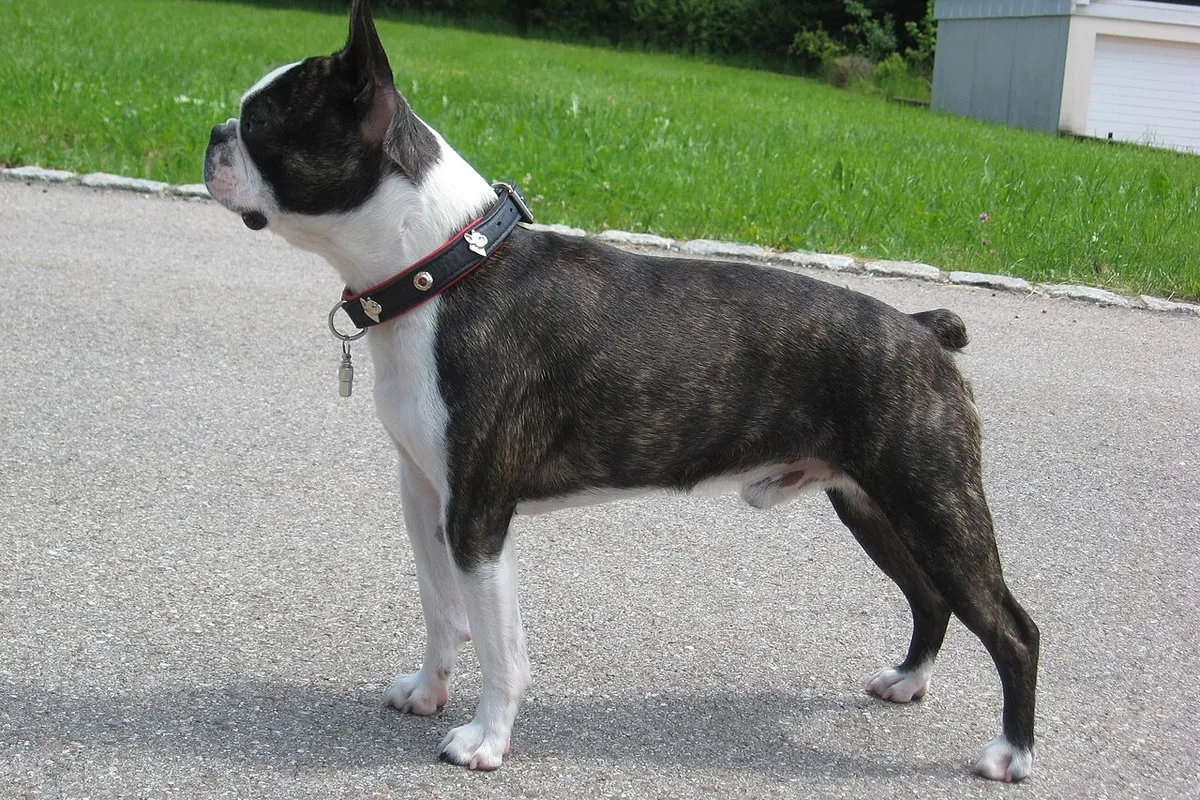
Boston Terrier at a glance
| Trait | Detail |
|---|---|
| Origin | United States [1] |
| Breed group | FCI group 9 (companion and toy dogs), section 11, small Molossian dogs [1]; AKC Non-Sporting Group [2] |
| Weight | Three classes: under 15 lb (6.8 kg), 15 to under 20 lb (6.8–9 kg), and 20 to 25 lb (9–11.35 kg) [1] |
| Height | 10–12 in (25–30 cm) [2] |
| Life expectancy | Median survival 11.8 years in UK veterinary records [3] |
| Coat | Short, smooth, bright and fine; brindle, seal or black with white markings [1] |
Origin
According to the American Kennel Club, the breed descends from a dog named Judge, a cross between a Bulldog and the old English Terrier, acquired around 1870 by Robert C. Hooper of Boston. The Boston Terrier Club of America was founded in 1891, and the AKC registered its first Boston Terrier two years later [2].
The FCI standard calls the breed “a most dapper and charming American original” and gives particular weight to balance, expression, color and white markings [1].
Common health problems
- Breathing (BOAS): in a UK study of 104 Boston Terriers graded for BOAS, 37.5% were grade 0, 35.6% grade 1, 26.0% grade 2 and 1.0% grade 3. The share of grade 0 dogs was higher than in French Bulldogs (10%) and Bulldogs (15.2%) studied the same way. Narrow nostrils, a shorter face, white of the eye showing and a thicker neck relative to the chest were linked with BOAS [4].
- Hereditary cataract: Boston Terriers have two distinct forms. The early form affects puppies in their first months, is always bilateral and progressive and leads to total blindness; the late form usually starts after 3 years of age and is more variable [5].
- Other eye disease: Boston Terriers were one of seven flat-faced breeds studied at a US referral eye service, where corneal ulcers, dry eye, corneal pigmentation, immature cataracts and uveitis were the most frequent diagnoses [6]. After cataract surgery, glaucoma developed in 38.0% of operated Boston Terrier eyes and retinal detachment in 7.7% [7].
- Brain inflammation: at UK referral centers, Boston Terriers had 17 times the odds of crossbred dogs of meningoencephalitis of unknown origin, among the highest of all breeds [8].
- Brain tumors: in 9,574 dogs examined after death at a US veterinary school, the Boston Terrier was one of five breeds at increased risk of primary brain tumors [9].
In the same UK longevity study, Boston Terriers had a 1.3 times higher hazard of death than crossbred dogs [3].
Blood work, DNA tests and screening in Boston Terriers
We found no published Boston Terrier-specific reference intervals for routine blood tests, and no breed-specific lab quirk is described. Screening in the breed is mostly about breathing and eyes.
- BOAS grading: the Kennel Club and University of Cambridge scheme grades breathing from 0 to 3, at rest and after 3 minutes of exercise, from 12 months of age and every two years [10]. In Boston Terriers, body measurements overlap a lot between affected and unaffected dogs, so the authors consider grading more useful for selecting unaffected dogs [4].
- Blood count in BOAS: flat-faced dogs with BOAS grades 2–3 had a higher hematocrit and all grades a higher blood carbon dioxide than dogs with a normal muzzle, mostly within normal ranges [11]. Creatinine was also slightly higher [11].
- DNA test for early cataract: an HSF4 mutation was confirmed as the cause of early-onset hereditary cataract in Boston Terriers. It is not associated with the late-onset form, so a clear result does not rule out cataract later in life [5].
- Spinal fluid and MRI: at UK referral centers, 91.5% of dogs diagnosed with meningoencephalitis of unknown origin had both an MRI and a spinal fluid analysis [8].
Related articles
En français : Boston terrier.
Questions to ask your veterinarian
- Should my Boston Terrier have a BOAS breathing assessment, and what grade is he or she?
- Has my dog been DNA tested for early-onset hereditary cataract (HSF4)?
- How often should the eyes be examined, and should tear production be measured?
- Is my dog’s weight right, given the link with breathing problems?
- Which signs should make me worry about a neurological problem?
Get your Boston Terrier’s blood work explained.
AI DiagAnimals reads the blood count, kidney values and chemistry panel with your laboratory’s intervals, and prepares the questions for your vet. The service opens soon: leave your email to be told first.
Frequently asked questions
How long do Boston Terriers live?
In a large UK study, the median survival of Boston Terriers was 11.8 years, with a 1.3 times higher hazard of death than crossbred dogs [3].
Do Boston Terriers have breathing problems?
Some do. In a UK study, 27% of Boston Terriers had clinically significant BOAS (grades 2–3), but a higher share were free of signs than in French Bulldogs or Bulldogs [4].
What eye problems do Boston Terriers have?
Two forms of hereditary cataract, an early form in puppies and a late form after about 3 years of age [5]. Corneal ulcers, dry eye and uveitis are also among the most frequent eye diagnoses in flat-faced breeds [6].
Is there a DNA test for cataracts in Boston Terriers?
Yes, for the early-onset form, which is caused by an HSF4 mutation. The test does not detect the late-onset form [5].
Sources
- Fédération Cynologique Internationale. FCI breed standard N° 140: Boston Terrier. 2013. fci.be/Nomenclature/Standards/140g09-en.pdf
- American Kennel Club. Boston Terrier: breed information. akc.org/dog-breeds/boston-terrier
- McMillan KM et al. Longevity of companion dog breeds: those at risk from early death. Sci Rep. 2024;14:531 (supplementary table S3). doi.org/10.1038/s41598-023-50458-w
- Tomlinson F et al. BOAS in the Boston Terrier: a healthier screw-tailed breed? PLoS One. 2024;19(12):e0315411. doi.org/10.1371/journal.pone.0315411
- Mellersh CS et al. Mutation in HSF4 associated with early but not late-onset hereditary cataract in the Boston Terrier. J Hered. 2007;98(5):531-533. doi.org/10.1093/jhered/esm043
- Palmer SV et al. Ophthalmic disorders in a referral population of seven breeds of brachycephalic dogs: 970 cases (2008-2017). J Am Vet Med Assoc. 2021;259(11):1318-1324. doi.org/10.2460/javma.20.07.0388
- Foote BC et al. Retinal detachment and glaucoma in the Boston Terrier and Shih Tzu following phacoemulsification (135 patients): 2000-2014. Vet Ophthalmol. 2018;21(3):240-248. doi.org/10.1111/vop.12500
- Choi Y, O’Neill DG et al. Meningoencephalitis of unknown origin in dogs under veterinary referral care in England (2017-2021): a multicenter case control study. Front Vet Sci. 2025;12:1710593. doi.org/10.3389/fvets.2025.1710593
- Song RB et al. Postmortem evaluation of 435 cases of intracranial neoplasia in dogs and relationship of neoplasm with breed, age, and body weight. J Vet Intern Med. 2013;27(5):1143-1152. doi.org/10.1111/jvim.12136
- The Royal Kennel Club. Respiratory Function Grading Scheme. royalkennelclub.com/health-and-dog-care/health-dog-care/health/getting-started-with-health-testing-and-screening/respiratory-function-grading-scheme
- Facin AC et al. Evaluation of systemic consequences of brachycephalic obstructive airway syndrome in dogs. Vet Rec. 2025:e70176. doi.org/10.1002/vetr.70176
Laboratory methods and reference intervals vary. This article explains; it does not diagnose. For a decision about your pet, use the original report and talk to your veterinarian. Our editorial policy.