
 Français
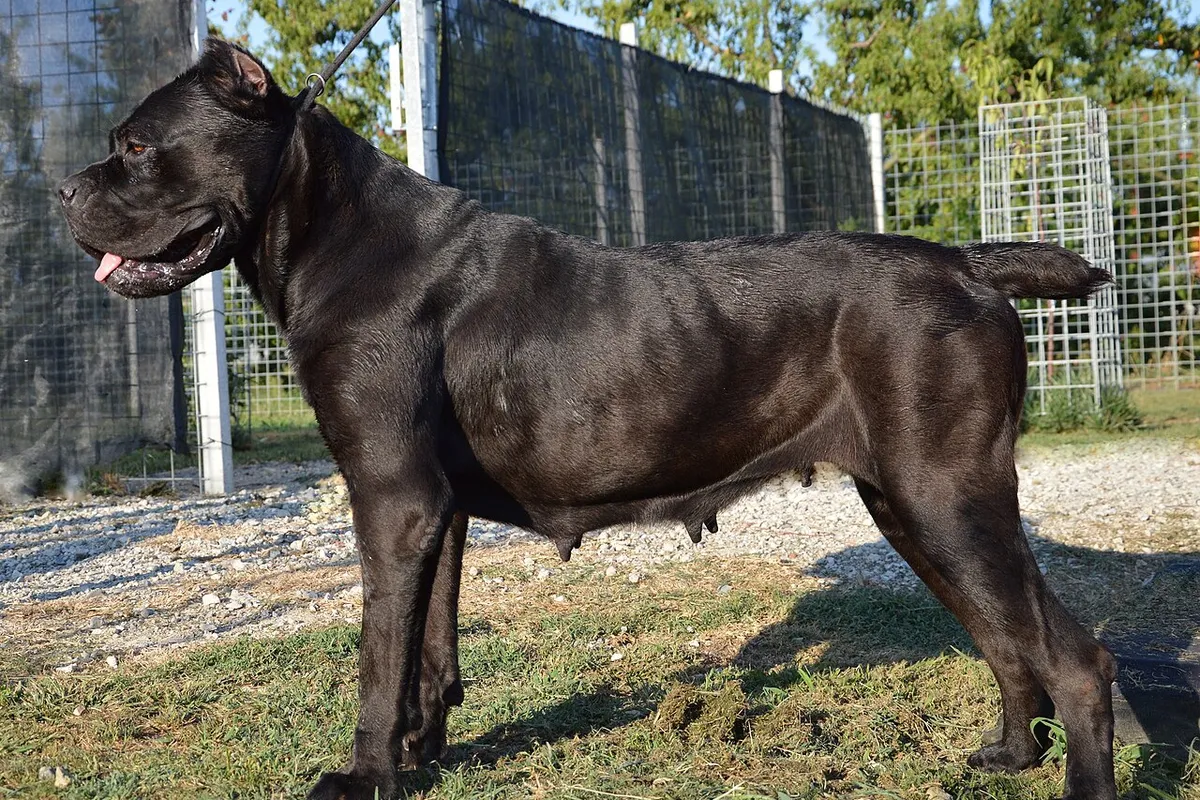
At a glance
| Trait | Detail |
|---|---|
| Origin | Italy [1] |
| Breed group | FCI group 2, section 2.1 (Molossian, Mastiff type) [1]; AKC Working Group [2] |
| Weight | Males 99–110 lb (45–50 kg), females 88–99 lb (40–45 kg) [1] |
| Height | Males 25–27 in (64–68 cm), females 23.5–25 in (60–64 cm), with a tolerance of 2 cm (about 1 in) [1] |
| Life expectancy | Median 8.1 years in a large UK study, based on relatively few dogs [3]; median 9.3 years in 232 dogs from 25 countries [4] |
| Coat | Short, shiny and very dense; black, grey, fawn, red or brindle [1] |
Origin
The Cane Corso descends from the old Roman Molossian dog. Once found all over Italy, it survived in the recent past mainly in Apulia and the neighboring regions of southern Italy. Its name comes from the Latin “cohors”, meaning protector, guardian of the farmyard. It guarded property, family and livestock, and was used for herding cattle and hunting big game [1].
It is a recent breed in the eyes of the FCI, which fully recognized it in 2007 [4].
Common health problems
- Hip dysplasia: in French screening X-rays of 1,338 Cane Corsos between 1997 and 2017, 51.9% had hip dysplasia, the highest of 10 breeds studied. The share fell from 72.7% to 49.9% over the period, the largest improvement of all breeds [5].
- Elbow dysplasia: in French screening from 2002 to 2022, the Cane Corso was one of the four breeds most affected, with the Dogue de Bordeaux, the Rottweiler and the Bernese Mountain Dog [6].
- Eyelid and eye problems: in an Italian study, 57.7% of Cane Corsos examined had at least one eye disorder presumed to be inherited, and ectropion (a lower eyelid that rolls outwards) made up 36.6% of these disorders [7].
- Cherry eye: prolapse of the third eyelid gland was 14.66 times more likely in Cane Corsos than in crossbreeds in UK practices, one of the highest odds of all breeds [8].
- Dental-skeletal-retinal anomaly (DSRA): an inherited disease with brittle, discolored teeth, disproportionate growth and progressive loss of vision. It is caused by a recessive variant of the MIA3 gene [9].
What is special in the Cane Corso’s blood work
Little has been published on the Cane Corso’s blood work, and we found no breed-specific reference intervals. Two points stand out.
Blood types. In Italian and Spanish blood donors, 2 of 49 Cane Corsos (4.1%) lacked the Dal red cell antigen, a finding new for the breed. Only 34.7% were DEA 1-positive and none were DEA 7-positive. A Dal-negative dog can be sensitized by a first transfusion, so cross-matching is needed before later transfusions [10]. See anemia in dogs.
DNA test for DSRA. The MIA3 variant showed a perfect match with the disease in 18 affected and 22 unaffected Cane Corsos, so dogs can be genotyped [9].
Screening schemes. Hip and elbow X-ray scoring and eye examinations are the main checks for the breed’s common problems [5, 6, 7].
For routine results, our guides to the blood count and to liver enzymes explain what each value means.
Related articles
En français : Cane corso.
Questions to ask your veterinarian
- Have my dog’s hips and elbows been X-rayed and scored?
- Are my dog’s eyelids normal, or is there ectropion or entropion?
- Has my dog’s blood type been checked in case a transfusion is ever needed?
- Have the parents been DNA-tested for dental-skeletal-retinal anomaly?
- Is my dog at a healthy weight for its joints?
Get your Cane Corso’s blood work explained.
AI DiagAnimals reads the blood count, liver and kidney values and other results together with your laboratory’s intervals, and explains them in plain language. The service opens soon: leave your email to be told first.
Frequently asked questions
How long do Cane Corsos live?
A large UK study found a median of 8.1 years, based on relatively few Cane Corsos [3]. A study of 232 dogs from 25 countries found a median of 9.3 years [4].
Do Cane Corsos have hip problems?
Yes. In French screening X-rays, 51.9% had hip dysplasia, although the share fell from 72.7% to 49.9% between 1997 and 2017 [5].
What eye problems do Cane Corsos have?
Ectropion was the most common inherited eye disorder in an Italian study [7], and cherry eye was 14.66 times more likely than in crossbreeds [8].
What health tests should a Cane Corso have?
Hip and elbow X-ray scoring [5, 6], an eye examination [7] and a DNA test for dental-skeletal-retinal anomaly [9] address the best-documented problems.
What blood type are Cane Corsos?
Many are DEA 1-negative: only 34.7% of Italian and Spanish donors were positive, and a few lacked the Dal antigen [10].
Sources
- FCI. Standard No. 343: Cane Corso Italiano. 2023. fci.be/Nomenclature/Standards/343g02-en.pdf
- American Kennel Club. Cane Corso: dog breed information. akc.org/dog-breeds/cane-corso
- McMillan KM et al. Longevity of companion dog breeds: those at risk from early death. Sci Rep. 2024;14:531 (supplementary table S3). doi.org/10.1038/s41598-023-50458-w
- Korec E et al. Longevity of Cane Corso Italiano dog breed and its relationship with hair colour. Open Vet J. 2017;7(2):170-173. doi.org/10.4314/ovj.v7i2.15
- Baldinger A et al. Prevalence of canine hip dysplasia in 10 breeds in France, a retrospective study of the 1997-2017 radiographic screening period. PLoS One. 2020;15(7):e0235847. doi.org/10.1371/journal.pone.0235847
- Roels J et al. Prevalence of elbow dysplasia in 13 dog breeds in France: a retrospective radiographic study (2002-2022). Am J Vet Res. 2024;85(5). doi.org/10.2460/ajvr.23.12.0290
- Guandalini A et al. Epidemiology of ocular disorders presumed to be inherited in three large Italian dog breeds in Italy. Vet Ophthalmol. 2017;20(5):420-426. doi.org/10.1111/vop.12442
- O’Neill DG et al. Breed and conformational predispositions for prolapsed nictitating membrane gland (PNMG) in dogs in the UK: a VetCompass study. PLoS One. 2022;17(1):e0260538. doi.org/10.1371/journal.pone.0260538
- Christen M et al. MIA3 splice defect in Cane Corso dogs with dental-skeletal-retinal anomaly (DSRA). Genes (Basel). 2021;12(10):1497. doi.org/10.3390/genes12101497
- Proverbio D et al. Prevalence of Dal blood type and dog erythrocyte antigens (DEA) 1, 4, and 7 in canine blood donors in Italy and Spain. BMC Vet Res. 2020;16:126. doi.org/10.1186/s12917-020-02351-1
Laboratory methods and reference intervals vary. This article explains; it does not diagnose. For a decision about your pet, use the original report and talk to your veterinarian. Our editorial policy.