
 Français
At a glance
| Trait | Detail |
|---|---|
| Origin | Germany [1] |
| Breed group | FCI group 7, section 1.1 (Continental Pointing Dogs, braque type) [1]; AKC Sporting Group [2] |
| Weight | Males 55–70 lb (25–32 kg), females 45–60 lb (20–27 kg) [2] |
| Height | Males 24.4–26.0 in (62–66 cm), females 22.8–24.8 in (58–63 cm) [1] |
| Life expectancy | Median 13.4 years in a large UK study, with a lower risk of early death than crossbreeds [3] |
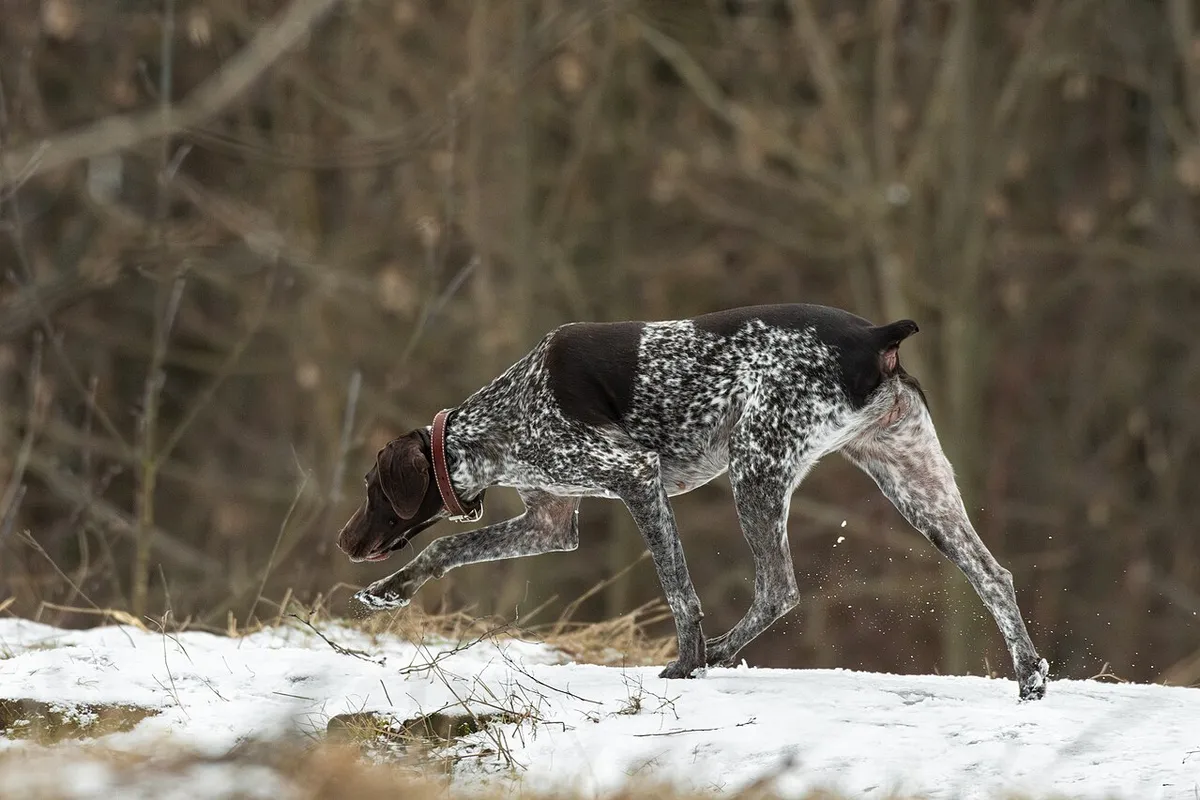
| Coat | Short, dense, rough and hard to the touch; brown, brown roan or white with brown markings, and the same shades in black [1] |
Origin
The breed goes back to pointing dogs used to hunt birds with nets and with falcons, which reached the German courts by way of France, Spain and Flanders. After the double-barreled gun appeared around 1750, the pure pointer was gradually turned into a versatile gundog. The breed’s studbook, the “Zuchtbuch Deutsch-Kurzhaar”, has been published since 1897, and Prince Albrecht zu Solms-Braunfeld set out its breed traits and first trial rules [1].
The FCI calls it the German Shorthaired Pointing Dog (Deutsch Kurzhaar). The American Kennel Club recognized it in 1930 and places it in the Sporting Group [1, 2].
Common health problems
- Gastric dilatation-volvulus (bloat): the German Shorthaired Pointer is one of the breeds with a higher risk than mixed-breed dogs. In a genetic study of 147 dogs with bloat, a variant that seemed to protect against it was found only in Collies, German Shorthaired Pointers and Great Danes [10]. The Weimaraner is another pointing breed at higher risk [10].
- Exfoliative cutaneous lupus erythematosus (ECLE): an inherited, recessive scaling skin disease. Two copies of a UNC93B1 variant were found in all 23 affected German Shorthaired Pointers and in one affected Vizsla, but in none of 845 control dogs [5]. In 7 dogs with ECLE, the kidneys showed an immune-complex glomerular disease similar to lupus nephritis in people [6].
- Junctional epidermolysis bullosa: an inherited disease in which the skin blisters and separates, caused by an insertion in the LAMA3 gene. Of 750 German Shorthaired Pointers tested in Italy from 2009 to 2018, 97 (12.9%) were carriers, and the variant became rarer over the years [7].
- Type 2 von Willebrand disease: an inherited bleeding disorder. In a line of German Shorthaired Pointers, every dog with a von Willebrand factor level under 70% of normal carried a VWF variant, and a PCR test was used to breed variant-free puppies [8].
- Cone degeneration: an inherited day blindness with loss of cone function in adult dogs, caused in this breed by a missense variant of the CNGB3 gene [9].
- Hip dysplasia is uncommon: in Swedish screening X-rays from 2007 to 2016, only 4.7% of 725 German Shorthaired Pointers had hip dysplasia, one of the three lowest rates of 72 breeds [4].
What is special in the German Shorthaired Pointer’s blood work
We found no breed-specific reference intervals for routine blood work. Several breed disorders, however, show on blood and urine tests.
Urine protein in dogs with ECLE. Of 7 dogs with ECLE, 5 had proteinuria on urinalysis or urine protein-to-creatinine ratio, 2 had intermittently low albumin and none had raised kidney values. The authors advise checking kidney function in affected dogs for early detection [6]. See protein in urine and albumin and globulin.
Bleeding tests. Type 2 von Willebrand disease is identified by a low von Willebrand factor level, and the VWF variant can be found with a DNA test [8].
Taurine. In a pilot study, 12 healthy German Shorthaired Pointers had significantly higher serum taurine than 10 healthy Golden Retrievers, a breed in which cases of diet-associated dilated cardiomyopathy have been reported [11].
Blood types. In an Italian study, 23 of 30 German Shorthaired Pointers (76.7%) were DEA 1-positive [12]. Blood typing before a transfusion is explained in anemia in dogs.
Screening. The AKC lists hip and elbow evaluation, a cardiac exam, an eye examination by a veterinary ophthalmologist and the DNA test for cone degeneration as the recommended health tests [2].
Related articles
En français : Braque allemand.
Questions to ask your veterinarian
- Have the parents been DNA-tested for ECLE, junctional epidermolysis bullosa, von Willebrand disease and cone degeneration?
- What are the early signs of bloat, and what should I do if I see them?
- If my dog has scaly skin lesions, could it be ECLE, and should its urine protein be checked?
- Should my dog’s von Willebrand factor be checked before surgery?
- Have my dog’s hips, elbows, heart and eyes been screened?
Get your German Shorthaired Pointer’s blood work explained.
AI DiagAnimals reads the blood count, the kidney values, the urine protein and the other results together with your laboratory’s intervals, and explains them in plain language. The service opens soon: leave your email to be told first.
Frequently asked questions
How long do German Shorthaired Pointers live?
A large UK study found a median lifespan of 13.4 years, with a lower risk of early death than crossbreeds [3].
Are German Shorthaired Pointers prone to bloat?
Yes. The breed is among those with a higher risk of gastric dilatation-volvulus than mixed-breed dogs [10].
What is ECLE in German Shorthaired Pointers?
Exfoliative cutaneous lupus erythematosus is an inherited scaling skin disease caused by a UNC93B1 variant [5]. Affected dogs can develop a lupus-like kidney disease with protein in the urine [6].
What DNA tests should a German Shorthaired Pointer have?
The variants behind ECLE [5], junctional epidermolysis bullosa [7], type 2 von Willebrand disease [8] and cone degeneration [9] are known and can be detected by genotyping. The AKC lists the cone degeneration test among the recommended screens [2].
Do German Shorthaired Pointers get hip dysplasia?
Rarely compared with other breeds: only 4.7% of those screened in Sweden had hip dysplasia [4].
Sources
- FCI. Standard No. 119: Deutsch Kurzhaar (German Shorthaired Pointing Dog). 2001. fci.be/Nomenclature/Standards/119g07-en.pdf
- American Kennel Club. German Shorthaired Pointer: dog breed information. akc.org/dog-breeds/german-shorthaired-pointer
- McMillan KM et al. Longevity of companion dog breeds: those at risk from early death. Sci Rep. 2024;14:531 (supplementary table S3). doi.org/10.1038/s41598-023-50458-w
- Engdahl K et al. Prevalence of hip and elbow dysplasia in young adult dogs in Sweden. Vet Rec. 2026;198(12):e560-e573. doi.org/10.1002/vetr.70224
- Leeb T et al. A missense variant affecting the C-terminal tail of UNC93B1 in dogs with exfoliative cutaneous lupus erythematosus (ECLE). Genes (Basel). 2020;11(2):159. doi.org/10.3390/genes11020159
- Amerman HK et al. German Shorthaired Pointer dogs with exfoliative cutaneous lupus erythematosus develop immune-complex membranous glomerulonephropathy. Vet Pathol. 2023;60(6):843-848. doi.org/10.1177/03009858231173362
- Frattini S et al. Genetic trend of the junctional epidermolysis bullosa in the German shorthaired pointer in Italy. Vet Rec Open. 2021;8(1):e15. doi.org/10.1002/vro2.15
- Kramer JW et al. A von Willebrand’s factor genomic nucleotide variant and polymerase chain reaction diagnostic test associated with inheritable type-2 von Willebrand’s disease in a line of German shorthaired pointer dogs. Vet Pathol. 2004;41(3):221-228. doi.org/10.1354/vp.41-3-221
- Sidjanin DJ et al. Canine CNGB3 mutations establish cone degeneration as orthologous to the human achromatopsia locus ACHM3. Hum Mol Genet. 2002;11(16):1823-1833. doi.org/10.1093/hmg/11.16.1823
- Piras IS et al. Identification of genetic susceptibility factors associated with canine gastric dilatation-volvulus. Genes (Basel). 2020;11(11):1313. doi.org/10.3390/genes11111313
- Bagardi M et al. Preliminary data on echocardiographic evaluation and serum taurine concentration in healthy dogs of two breeds (10 Golden Retrievers and 12 German Shorthaired Pointers) with different predispositions to nutritional dilated cardiomyopathy: a pilot study. Animals (Basel). 2022;12(21):2924. doi.org/10.3390/ani12212924
- Medina Valentin AA, Gavazza A, Lubas G. Prevalence of dog erythrocyte antigen 1 in 7,414 dogs in Italy. Vet Med Int. 2017;2017:5914629. doi.org/10.1155/2017/5914629
Laboratory methods and reference intervals vary. This article explains; it does not diagnose. For a decision about your pet, use the original report and talk to your veterinarian. Our editorial policy.