
 Français
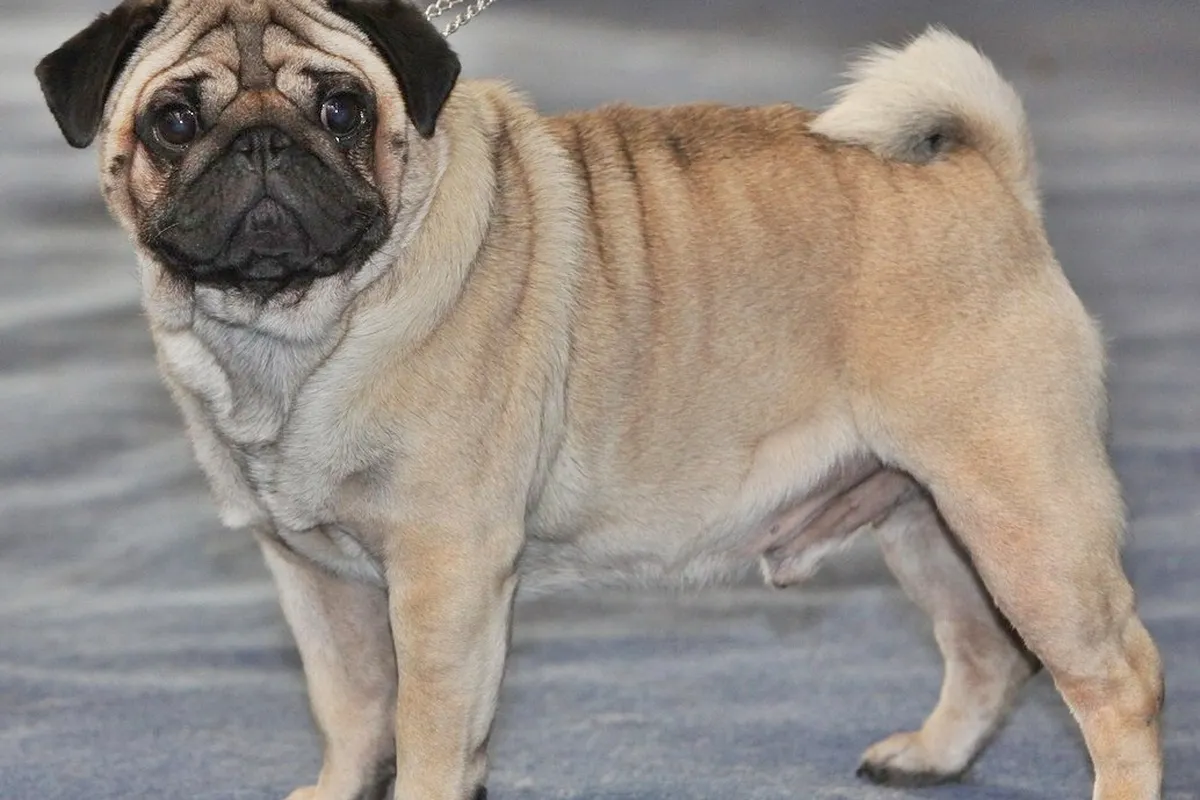
Pug at a glance
| Trait | Detail |
|---|---|
| Origin | China; patronage Great Britain [1] |
| Breed group | FCI group 9 (companion and toy dogs), section 11, small Molossian type dogs [1]; AKC Toy Group [2] |
| Weight | Ideal 14–18 lb (6.3–8.1 kg) in the FCI standard [1]; median 19.7 lb (8.95 kg) in UK pet Pugs [4] |
| Height | 10–13 in (25–33 cm) [2] |
| Life expectancy | Median survival 11.6 years in UK veterinary records [3] |
| Coat | Fine, smooth, soft, short and glossy; silver, apricot, fawn or black [1] |
Origin
The breed standard lists China as the Pug’s home country. It reached Europe with traders of the Dutch East India Company and was admired in the Netherlands as early as the 1500s, then arrived in England with William III. Until 1877 the breed was seen there only in fawn, when a black pair was brought from Asia [1].
The current standard states that pinched nostrils are unacceptable, that the eyes must never be protruding, and that obesity is unacceptable [1].
Common health problems
A UK study compared 4,308 Pugs with 21,835 other dogs. Pugs had higher odds for 23 of 40 common disorders, and lower odds for 7 [4].
- Breathing (BOAS): 54 times the odds of other dogs, and narrowed nostrils 51 times [4]. See also the French Bulldog and the English Bulldog, two other flat-faced breeds.
- Eyes: corneal ulcers had 13 times the odds of other dogs [4], and dry eye (keratoconjunctivitis sicca) 22 times the odds of crossbred dogs [5]. Corneal disorders affected 8.7% of Pugs in one year in an earlier study [6].
- Skin and ears: skin fold dermatitis had 11 times the odds, and ear discharge almost 10 times [4].
- Weight: overweight or obesity was the most common problem, recorded in 13.2% of Pugs in one year [6].
- Spine: among 106 Pugs seen for spinal disease at a UK referral hospital, 74.5% had signs that came on slowly. The most common diagnoses were spinal arachnoid diverticula and chronic disc protrusion, each 24.0% [7].
- Brain inflammation: at UK referral centers, Pugs had 6.3 times the odds of crossbred dogs of meningoencephalitis of unknown origin [8]. Pug dog encephalitis, or necrotizing meningoencephalitis, is a potentially fatal form [9].
- Liver shunt: congenital portosystemic shunts were diagnosed in 1.3% of Pugs in a US database of teaching hospitals, against 0.05% of mixed-breed dogs [10]. See liver shunt in dogs.
- Fewer heart murmurs: Pugs had about a quarter of the odds of other dogs of a heart murmur [4].
Blood work, DNA tests and screening in Pugs
We found no published Pug-specific reference intervals for routine blood tests. The main screening tools in the breed are a breathing assessment and a DNA test.
- BOAS grading: the Kennel Club and University of Cambridge scheme grades breathing from 0 to 3, at rest and after 3 minutes of exercise, from 12 months of age and every two years [11].
- Blood count in BOAS: flat-faced dogs with BOAS grades 2–3 had a higher hematocrit and all grades a higher blood carbon dioxide than dogs with a normal muzzle, mostly within normal ranges [12]. Creatinine was also slightly higher [12].
- DNA test for Pug dog encephalitis: in 5,974 European Pugs tested between 2012 and 2020, the risk variant on chromosome 12 (CFA12:2605517delC) had an allele frequency of 25.7%; 7.4% of dogs carried two copies and 36.7% one copy. Pugs with signs of the disease were more often homozygous. The authors note that testing is recommended before breeding [9].
- Diagnosing brain inflammation: at UK referral centers, 91.5% of dogs diagnosed with meningoencephalitis of unknown origin had both an MRI and a spinal fluid analysis, and 92.5% were screened for infectious diseases [8].
- Liver shunt tests: for breeds at increased risk, the authors of the US study advise appropriate diagnostic tests in dogs with signs and in dogs used for breeding [10]. See the bile acids test.
Related articles
En français : Carlin.
Questions to ask your veterinarian
- Should my Pug have a BOAS breathing assessment, and what grade is he or she?
- Has my dog been DNA tested for the Pug dog encephalitis risk variant?
- Should the tear production be measured to check for dry eye?
- Is my Pug’s weight right, given the link with breathing problems?
- How should the skin folds and ears be cleaned and checked between visits?
Get your Pug’s blood work explained.
AI DiagAnimals reads the blood count, kidney and liver values and bile acids with your laboratory’s intervals, and prepares the questions for your vet. The service opens soon: leave your email to be told first.
Frequently asked questions
How long do Pugs live?
In a large UK study, the median survival of Pugs was 11.6 years, and their hazard of death was 1.34 times that of crossbred dogs [3].
What health problems do Pugs have?
Compared with other dogs, the strongest predispositions are BOAS, narrowed nostrils, corneal ulcers and skin fold dermatitis [4]. Overweight, corneal disorders and ear infections were the most common problems in an earlier study [6].
What is Pug dog encephalitis?
A potentially fatal inflammation of the brain, also called necrotizing meningoencephalitis. In European Pugs it is linked with a risk variant on chromosome 12; affected Pugs had a median age of onset of 1 year [9].
Is there a DNA test for Pug dog encephalitis?
Yes. A test detects the CFA12 risk variant. It does not mean a dog will become ill, but Pugs with the disease were more often homozygous for the variant [9].
What is BOAS grading for Pugs?
A breathing assessment by a trained vet, at rest and after 3 minutes of exercise, graded 0 to 3, from 12 months of age and every two years [11].
Sources
- Fédération Cynologique Internationale. FCI breed standard N° 253: Pug. 2026. fci.be/Nomenclature/Standards/253g09-en.pdf
- American Kennel Club. Pug: breed information. akc.org/dog-breeds/pug
- McMillan KM et al. Longevity of companion dog breeds: those at risk from early death. Sci Rep. 2024;14:531 (supplementary table S3). doi.org/10.1038/s41598-023-50458-w
- O’Neill DG et al. Health of Pug dogs in the UK: disorder predispositions and protections. Canine Med Genet. 2022;9(1):4. doi.org/10.1186/s40575-022-00117-6
- O’Neill DG et al. Keratoconjunctivitis sicca in dogs under primary veterinary care in the UK: an epidemiological study. J Small Anim Pract. 2021;62(8):636-645. doi.org/10.1111/jsap.13382
- O’Neill DG et al. Demography and health of Pugs under primary veterinary care in England. Canine Genet Epidemiol. 2016;3:5. doi.org/10.1186/s40575-016-0035-z
- Kerr S et al. Prevalence and breed predisposition for spinal diseases in pugs and French bulldogs. Vet Rec. 2025;196(4):e5122. doi.org/10.1002/vetr.5122
- Choi Y, O’Neill DG et al. Meningoencephalitis of unknown origin in dogs under veterinary referral care in England (2017-2021): a multicenter case control study. Front Vet Sci. 2025;12:1710593. doi.org/10.3389/fvets.2025.1710593
- van Renen J et al. Allele frequency of a genetic risk variant for necrotizing meningoencephalitis in pug dogs from Europe and association with the clinical phenotype. Front Vet Sci. 2024;11:1407288. doi.org/10.3389/fvets.2024.1407288
- Tobias KM, Rohrbach BW. Association of breed with the diagnosis of congenital portosystemic shunts in dogs: 2,400 cases (1980-2002). J Am Vet Med Assoc. 2003;223(11):1636-1639. doi.org/10.2460/javma.2003.223.1636
- The Royal Kennel Club. Respiratory Function Grading Scheme. royalkennelclub.com/health-and-dog-care/health-dog-care/health/getting-started-with-health-testing-and-screening/respiratory-function-grading-scheme
- Facin AC et al. Evaluation of systemic consequences of brachycephalic obstructive airway syndrome in dogs. Vet Rec. 2025:e70176. doi.org/10.1002/vetr.70176
Laboratory methods and reference intervals vary. This article explains; it does not diagnose. For a decision about your pet, use the original report and talk to your veterinarian. Our editorial policy.